
Most RPA backlogs are ranked by annoyance. The process that generates the loudest complaints gets the first bot, and three months later that bot spends half its runs handing work back to a person. Score candidates on volume and exception rate first, and the bots you build actually take work off the desk.
The Clerical Work Is Already Shifting
The labor market has moved ahead of most automation roadmaps. The Bureau of Labor Statistics' Occupational Outlook Handbook counts 1,532,400 bookkeeping, accounting and auditing clerk jobs in 2025 and projects that employment will decline 6 percent from 2025 to 2035. Its stated reason is that software has automated many of the tasks these clerks perform.
Billing is on the same path. BLS's 2025 to 2035 outlook for financial clerks projects a 4 percent decline overall and expects automated invoice processing software to raise the productivity of billing and posting clerks. The question for finance and RevOps leaders isn't whether this work gets automated. It's whether your bots take the right slice of it.
Why Bots Built on Annoyance Stall
- High exception rates. A process where one record in four needs judgment produces a bot that escalates one record in four. The team still works the queue, now with an extra handoff.
- Unstable inputs. Vendor invoices in ten layouts, spreadsheets someone reformats every quarter, a portal that changes its screens. Each change is a break, and each break lands on whoever owns the bot.
- Low volume. A painful task that runs twenty times a month rarely pays back the build and the upkeep.
- No exception owner. When the bot kicks a record out and nobody is assigned to it, the record sits until month-end close finds it.
Score Candidates Before You Build
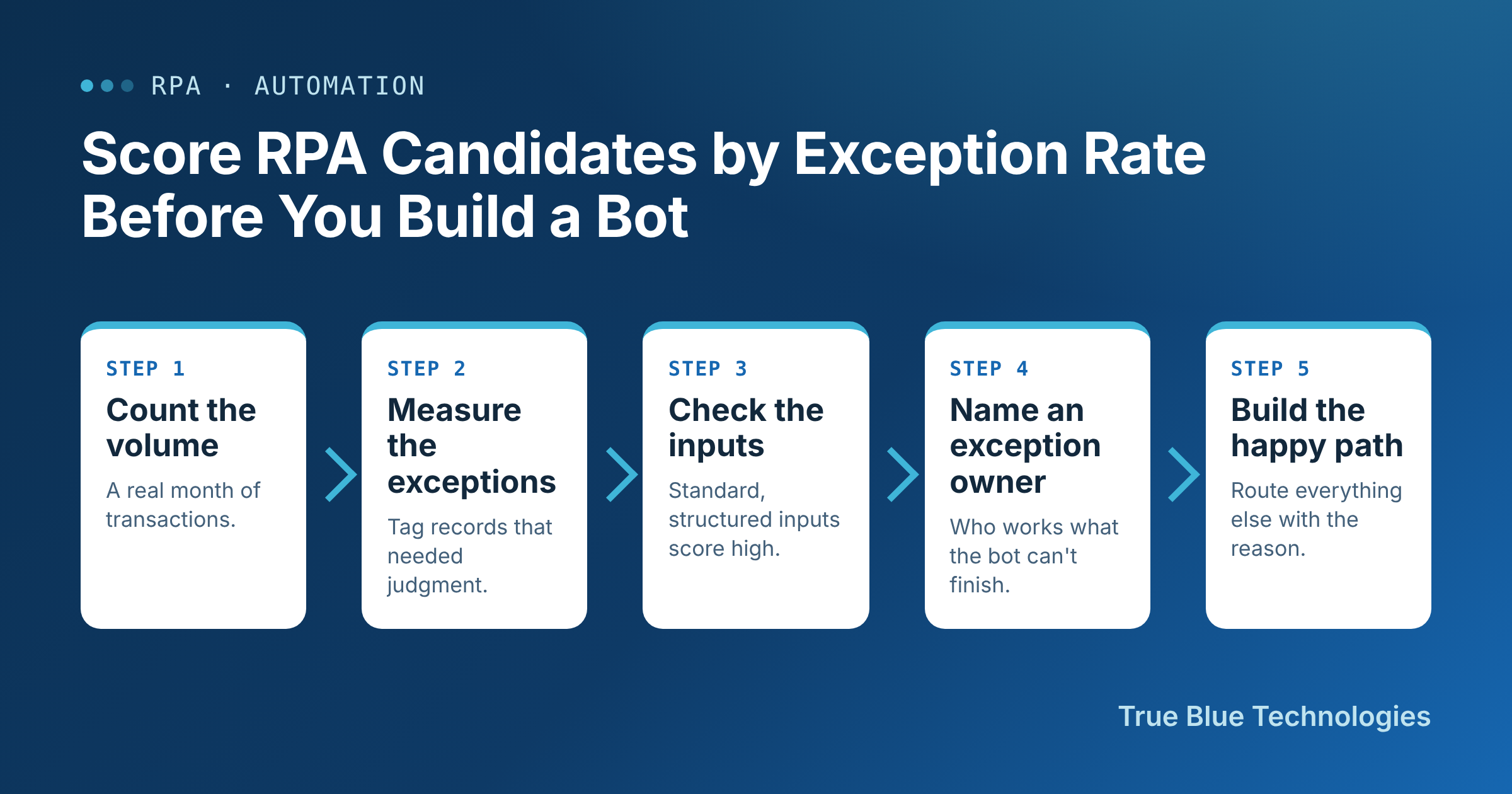
- Count the volume. Pull a real month of transactions from the system of record, not an estimate from the team. Volume times handling time is the ceiling on what the bot can save.
- Measure the exceptions. Sample at least a hundred records and tag every one that needed a judgment call, a lookup in another system, or a fix to the source data. That share is your exception rate.
- Check the inputs. List every format the process receives and how often each one changed in the last year. Standard, structured inputs score high. Free-form emails and scanned PDFs score low until you fix the intake.
- Name an exception owner. Decide who works the records the bot can't finish, how fast, and where they see them. If you can't name the person, the process isn't ready.
- Build the happy path. Automate the clean majority first and route everything else to the owner with the reason attached. Expand the rules only after the exception report shows you which cases repeat.
What Good Looks Like
Every candidate on the backlog has a volume, an exception rate and an input score next to it. The first bots go to high-volume, low-exception processes with standard inputs. Each bot has an exception queue with an owner, and the exception rate is reported monthly so you can drill down on what's still coming back.
Our Take
RPA pays off on boring, repeatable, high-volume work. It struggles wherever the real job is judgment. Measure that line before you build, and you'll spend your automation budget where it returns hours instead of handoffs. If you'd like help, we'll score your current backlog with you and show you which processes are ready for a bot and which need cleaner inputs first.